RU Marketplace
The Rutgers student community lacked a trusted way to buy and resell on campus. I designed it as a potential in-app feature that makes peer-to-peer transactions safe, fast, and campus-native.
Role
UX Researcher, UI Designer
Timeline
6 weeks
Team
3 UX Researcher, 1 UI Designer
Platform
Mobile
Overview
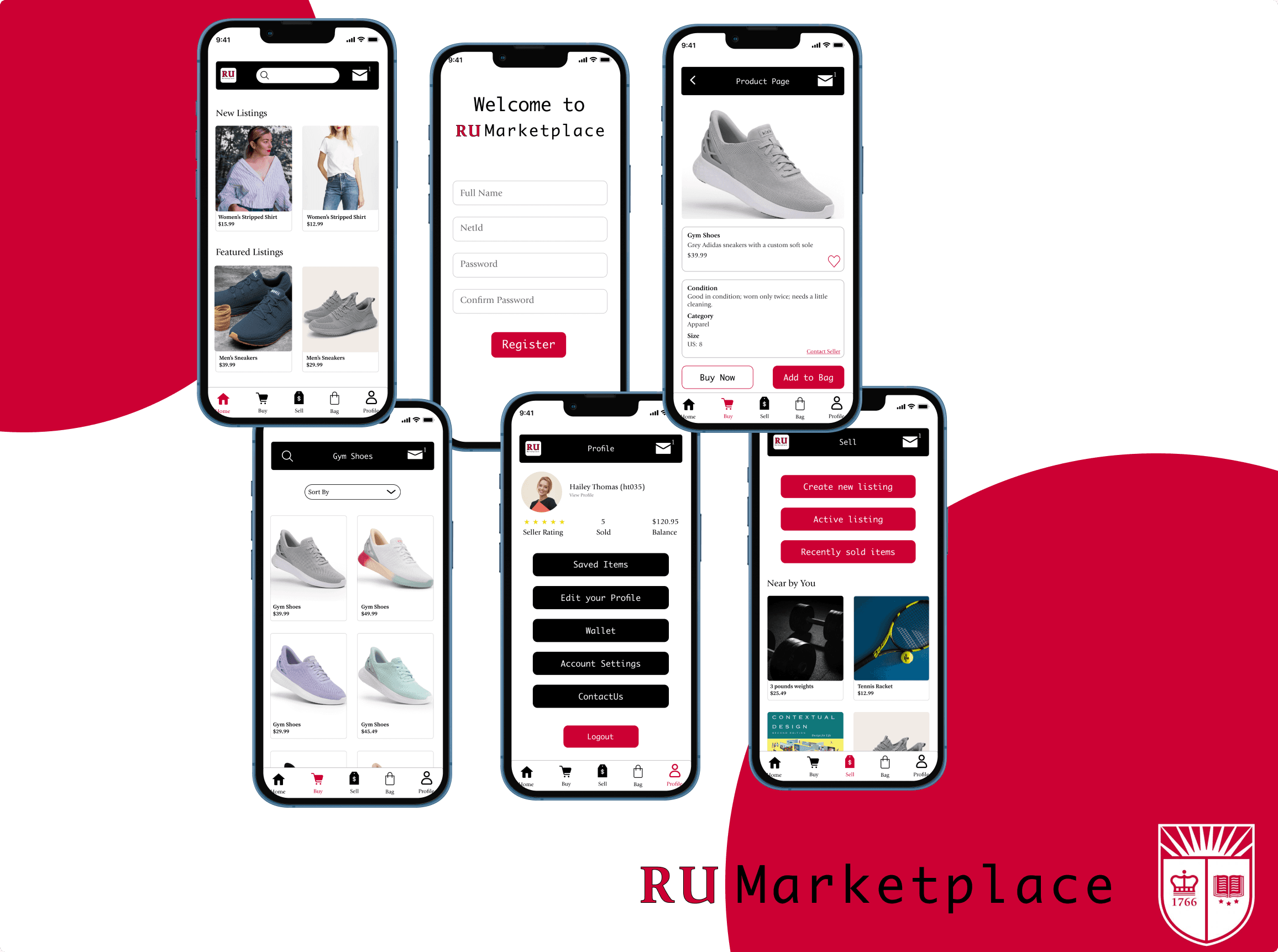
RU Marketplace is a proposed feature within the existing Rutgers University application that helps students buy and resell used items. Developed as a class project during my master’s program, it explored how a campus marketplace could support clearer information, easier communication, and greater trust between buyers and sellers.
My role
Everyone on the team participated in research, synthesis, design, prototyping, and usability testing. I independently designed the entire high-fidelity prototype, drawing on my previous experience researching Preloved's resale market.
The problem
Buying used products helps students manage expenses, while selling unwanted belongings provides extra income. However, resale applications can expose users to fake listings, unclear product information, scams, and unwanted messages.
We focused on the Rutgers student community looking for affordable products or wanting to sell belongings, especially during move-in and move-out. Our goal was to make buying and selling within the student community more convenient and transparent.
Research
Competitive analysis
We compared Poshmark, AptDeco, and OfferUp to understand their features, strengths, and limitations. Reviewing listings, search, messaging, payments, delivery, and buyer protection helped us identify areas to explore in student interviews.

Informal campus conversations
We spoke informally with students about the applications they used, their experiences, and their pain points. These unrecorded conversations helped us confirm whether the problem mattered to the Rutgers community.
User interviews
We conducted four one-on-one interviews: a pilot followed by three additional interviews. The pilot helped us refine question wording and add questions before the remaining sessions.
We used a scripted introduction to explain the process and follow-up questions to explore participants’ experiences in more detail. All four interviews contributed to our affinity mapping.
Synthesizing the research
Interpretation sessions and affinity mapping
We reviewed the interviews together and grouped observations into motivations, challenges, and positive experiences. Three recurring concerns shaped our design direction:
Trust: Scammers, bots, dishonest sellers, and fake listings made students hesitant to transact.
Product information: Vague descriptions, inconsistent prices, and listings remaining available after items had sold created uncertainty.
Communication: Unanswered messages, spam, and unwanted contact made it difficult to connect with buyers and sellers.
Students also valued affordability, earning extra money, convenience, local buying, useful filters, and access across devices.

Journey mapping
We mapped the experience from registration through browsing, purchasing, and follow-up to identify moments of uncertainty. This informed proposed features such as NetID verification, listings and messaging restricted to verified users, a request-to-contact option, and fewer advertisements within listings.
User personas
We created three personas representing a commuting graduate student, a graduating student, and a first-year undergraduate. They helped us consider differences in available time, affordability, familiarity with resale applications, and buying or selling needs throughout university life.
Developing the concept
During our visioning session, we developed the idea of integrating RU Marketplace into the Rutgers application. Students could buy and sell textbooks, electronics, clothing, and furniture within their university community, supporting affordability and the reuse of belongings.
We explored different approaches through sketches and combined them into a final direction. We also considered:
Access while commuting, in dorms, or off campus.
Saving activity to a NetID-linked profile so users can continue across devices.
Sharing listings through messaging and social media.
Using familiar language and clearly explaining what information buyers and sellers could see.

Structuring the experience
We developed three models before moving into the prototype:
User flow: Mapped the steps from login and verification through buying, selling, and completing a transaction.
Sitemap: Organized buying, selling, search, messaging, and profile management.
User Environment Design: Defined the functions available within each area and how those areas connected.
These models guided the content, navigation, and actions needed in our wireframes.

Prototyping
We translated our sketches and models into low-fidelity wireframes. With limited time, we divided the detailed work across navigation, buying, and selling while continuing to collaborate.
I then designed the complete high-fidelity prototype, covering registration, login, browsing, search, buying, selling, messaging, and profile management. I followed the Rutgers application's visual style to reflect the proposed integration.

Test the prototype
Usability testing
We conducted scripted usability sessions with three participants over Zoom. Participants explored the navigation and completed buying and selling tasks so we could assess whether the process and information were understandable.
Participants also commented on the idea of a marketplace specifically for the Rutgers community:
“I have always felt a little hesitant when using a reselling application to sell any item because I thought I would somehow end up scammed. It's good that you're focusing on a product specifically for Rutgers students. I feel the transparency within the application as I know what I am doing in each process”
“This is a great platform for students to feel safe when buying and selling items within the Rutgers community. It is an enhancement feature for the current Rutgers application.”
These comments reflected participants’ perceived clarity and trust in the prototype.
Design revisions
Following testing, we made the revisions shown in our before-and-after screens:

We informally shared the revised prototype with classmates but did not conduct another formal usability test. The effectiveness of the revisions was therefore not formally established.
Outcome
The project concluded with a revised high-fidelity prototype. We asked students whether they would use the marketplace if it were part of the Rutgers student page and began conversations about potential integration, but did not pursue them further.
The feature was not officially integrated into the Rutgers application. Its intended benefits, including affordable transactions, reuse, and clearer communication, would require further development and evaluation.
Reflection
This project gave me experience collaborating across the full design process while taking responsibility for the high-fidelity prototype. It helped me recognize user research as a strength and visual design as an area to continue developing.
My work on Preloved gave me a foundation in the resale market that I could bring into our research discussions and use when translating the team’s shared work into the prototype.
Explore Other Projects
